Web Design
Construction Company Website Design in Malaysia
What a construction, renovation or M&E contractor website in Malaysia needs to win tenders: projects, certifications, WhatsApp, speed, and what it costs.
 By Zahid Aramai

Construction is a referral business, and that is exactly why the website matters more than most contractors think. Nobody hires a main contractor from a Google search alone, but every referral, every tender shortlist and every developer’s procurement officer searches the company name before the first call. What they find in those thirty seconds either confirms the referral or quietly kills it.
I have built websites for engineering consultancies, M&E contractors, packaging and industrial firms and specialist subcontractors in Malaysia. The ones that work share a structure. This is it.
What the visitor is checking
Put yourself in the seat of the person who just received your company profile PDF. They open the website and want to answer four questions quickly: Is this company real and still operating? Have they done work like mine? Are they registered and insured for it? Who do I talk to?
Everything on the site serves one of those four. Anything that does not, a stock photo of a hard hat on a blueprint for example, is noise.
The diagram pairs each question with the page that answers it.
The pages that win the shortlist
Projects, with real photos. This is the page people read. For each project: the client or project type, location, scope, value band if you are allowed to say it, completion year, and photos you took on site. Sort by sector so a hospital client finds hospital work in one click. Ten real projects beat a hundred logos.
Services by discipline. Civil and structural, M&E, interior fit-out, renovation, maintenance contracts: one page each, written in the words the client uses in a tender document, with the kind of projects each applies to. These pages also rank for searches like “M&E contractor Selangor” if written properly.
Registrations and certifications. CIDB grade and category, SSM details, ISO certifications, safety records, licences for specialist work. Show the certificate numbers and the expiry dates. Procurement officers check these; make it easy and you have already beaten half the competition.
Team and contact. A named director or project manager, a real office address with a map, the WhatsApp number of the person who actually answers, and a quotation request form that asks the right questions: location, scope, timeline, budget range, drawings if any.
Safety and quality. One page on your safety policy, incident record and method is worth more to a developer than any amount of design flourish.
News or project updates, optional but useful. Three short posts a year, a completed handover, a new ISO certificate, a site visit by a client, keep the site visibly alive. A procurement officer who sees the last update dated four years ago assumes the company is dormant, and a dormant-looking company does not make the shortlist. Each update is also one more page that can rank for the project type and the location.
In short, each page has one job and carries one kind of proof:
| Page | Its job | Proof it carries |
|---|---|---|
| Projects | Show work like theirs | Location, scope, year, site photos |
| Services by discipline | Match the tender wording | Project types for each discipline |
| Registrations | Pass the compliance check | Grade, certificate numbers, expiry dates |
| Team and contact | Reach the right person | Named contact, address, map, WhatsApp |
| Safety and quality | Reassure a developer | Policy, incident record, method |
| News or updates | Show the company is active | Dated handovers and new certificates |
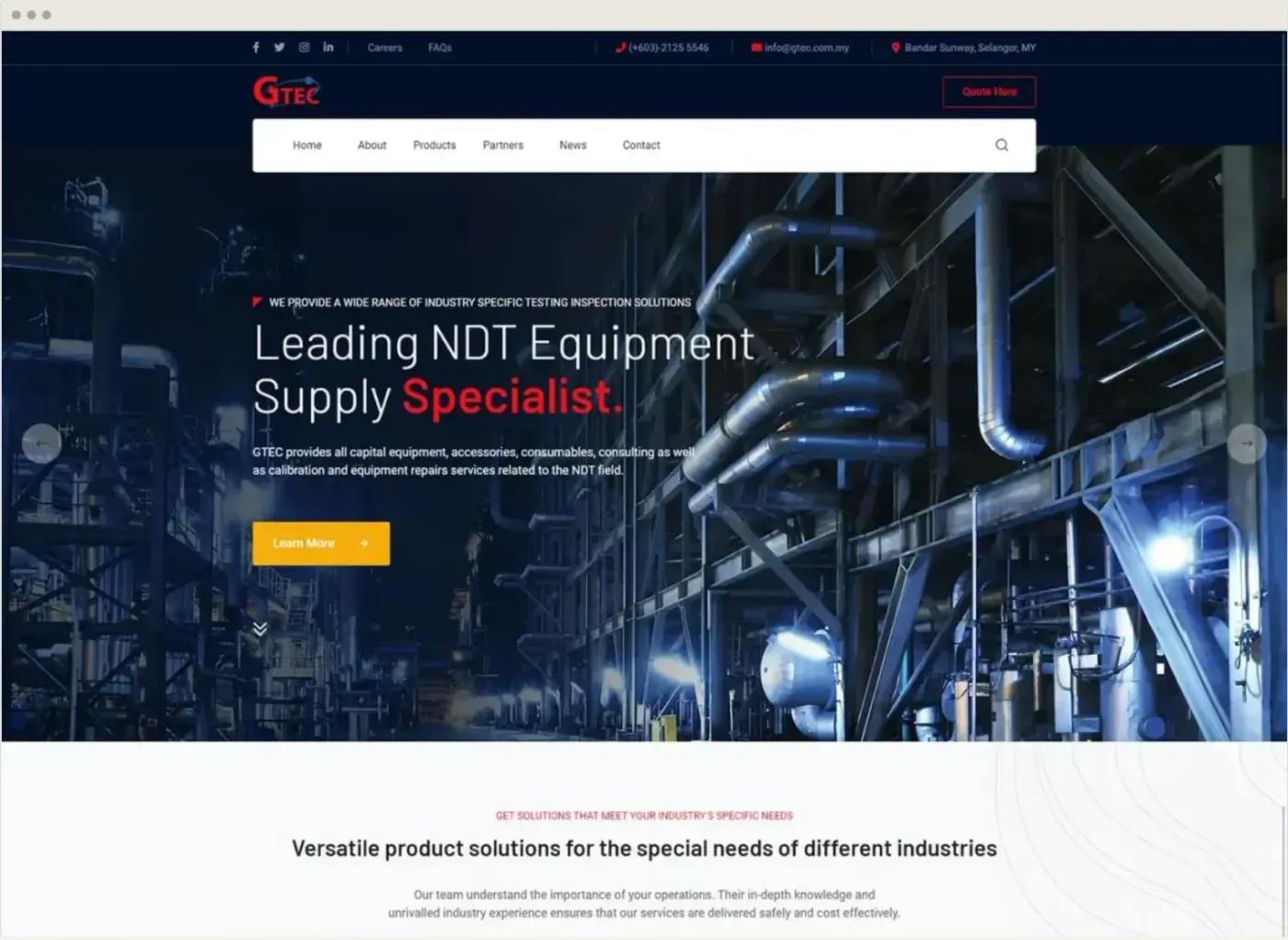
Here is the top of a real industrial site I designed, the GTEC NDT build: phone, email, location and a quote button sit above the menu, before any marketing copy.
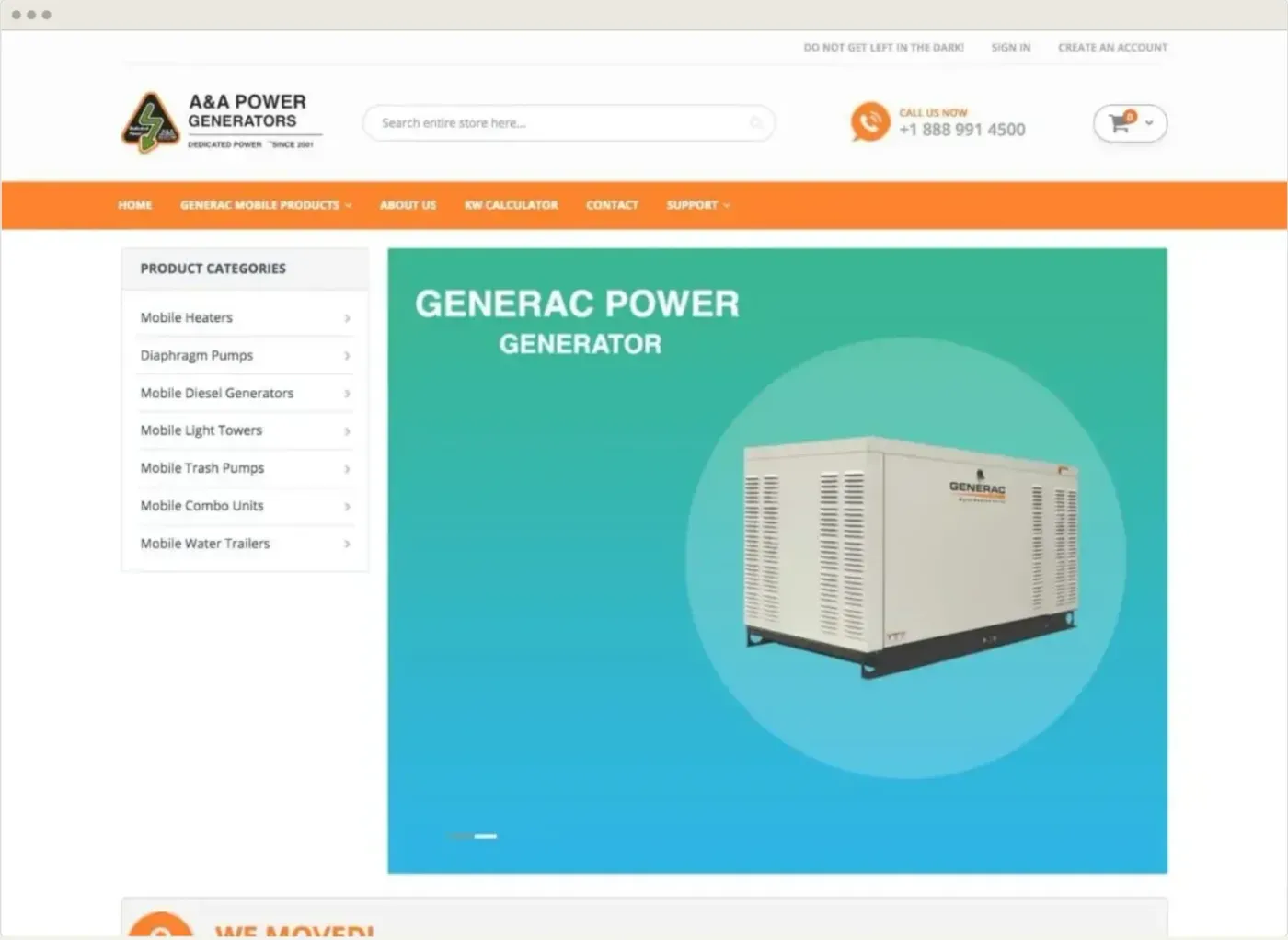
The A&A Power Generators build does the same for services: every product line is listed and one click from the home page.
Details that make the difference
WhatsApp everywhere. Site managers and QS staff live on WhatsApp, and so do the clients who hire them. Every page gets a button with a pre-filled message that names the service, and the taps are counted so you know which page produced the enquiry.
Speed on a phone in a site office. Your visitors are often on a construction site with poor signal. Compressed photos, no heavy animations and a page that loads in under three seconds on mobile data is a business requirement, not a technical nicety.
A downloadable company profile. Keep the PDF, but put it behind a single button and keep the website itself as the current version. Procurement teams forward PDFs; their managers open the website. Date the PDF and replace it when the project list changes, because an outdated profile circulating with a current website sends mixed signals about how organised the company is.
Bahasa Malaysia where tenders need it. Many contractors serve both government and private clients. A bilingual site, English and Bahasa Malaysia, handles both without doubling the cost.
| Detail | Why it matters | How to check it |
|---|---|---|
| WhatsApp on every page | Site staff and clients live on it | Tap it on three different pages |
| Fast on mobile data | Visitors are on site with weak signal | Open the site on a phone, Wi-Fi off |
| Dated company profile PDF | Procurement teams forward PDFs | The date matches the project list |
| Bahasa Malaysia version | Government tenders lean Bahasa Malaysia | Switch language on a project page |
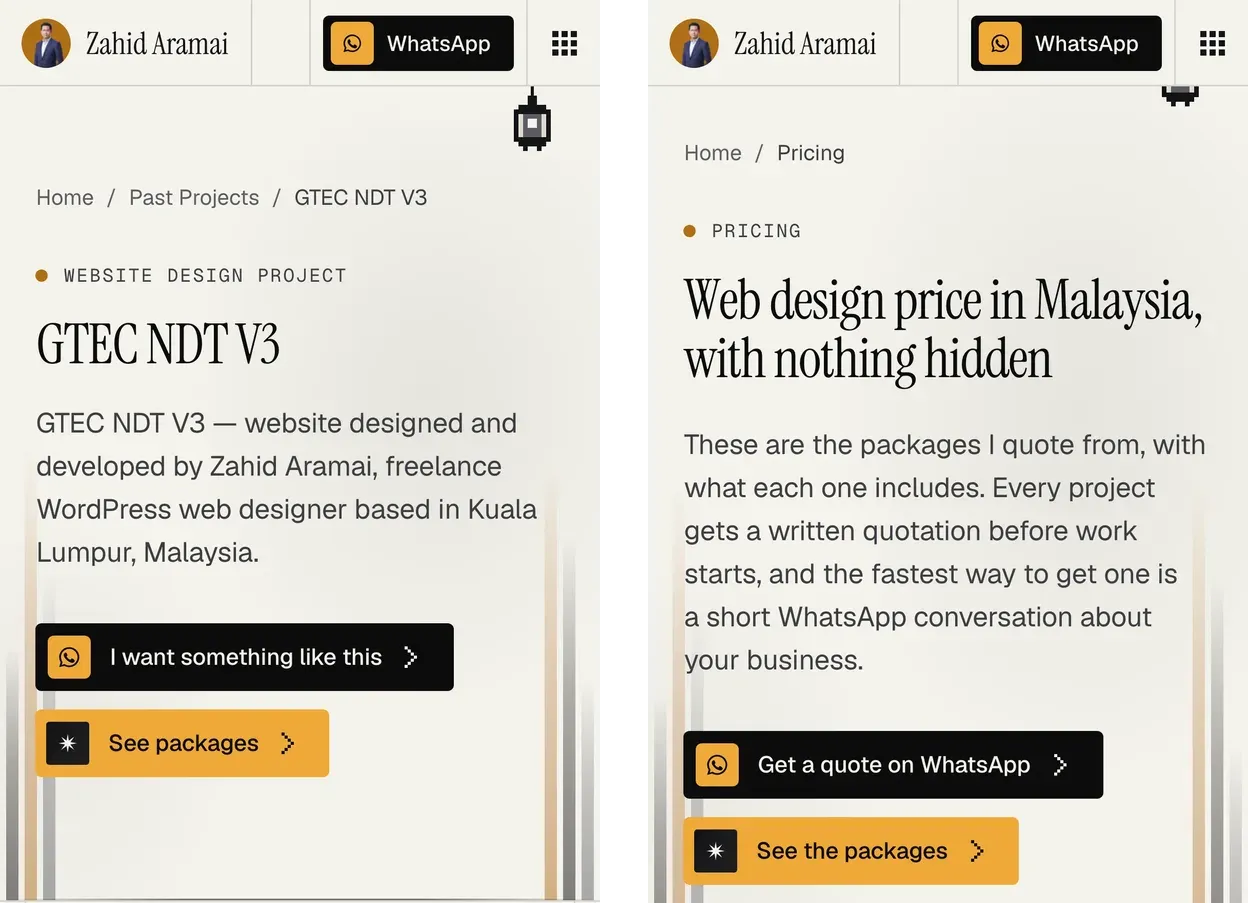
On my own site the WhatsApp button sits in the header of every page and again beside the main content, so a phone visitor never has to scroll to find it.
How to build one project page that proves capability
The projects page is where tenders are won or lost, so it is worth being specific about what one project entry holds. This is the structure I use.
The wireframe shows the order on the page; the notes below explain each block.
Headline facts. Project name or type, client category, location, your role (main contractor, subcontractor, M&E package, design and build), contract period and completion year. If the client is confidential, say so and describe the client type instead, for example “private hospital operator”.
Scope in plain words. Three to six lines on what you actually delivered. “Supply and install of chilled water piping and air handling units across four floors” tells an evaluator more than “complete M&E works”.
The problem on site. One short paragraph on what made the job hard: a tight handover date, an occupied building, a difficult site access. This is the part competitors leave out, and it is the part that shows experience.
Photos in sequence. Before, during and after, taken on your own phone or camera. Add a caption that says what the viewer is looking at. Three honest photos beat twelve glossy renders.
Figures you are allowed to share. Contract value band, floor area, number of units or length of works, only if the client has no objection. Never publish a number you cannot back up in a tender clarification meeting.
Add a filter by sector and by year, and a visible count at the top such as the number of completed projects. If you can list that number honestly, it is a stronger trust signal than any slogan.
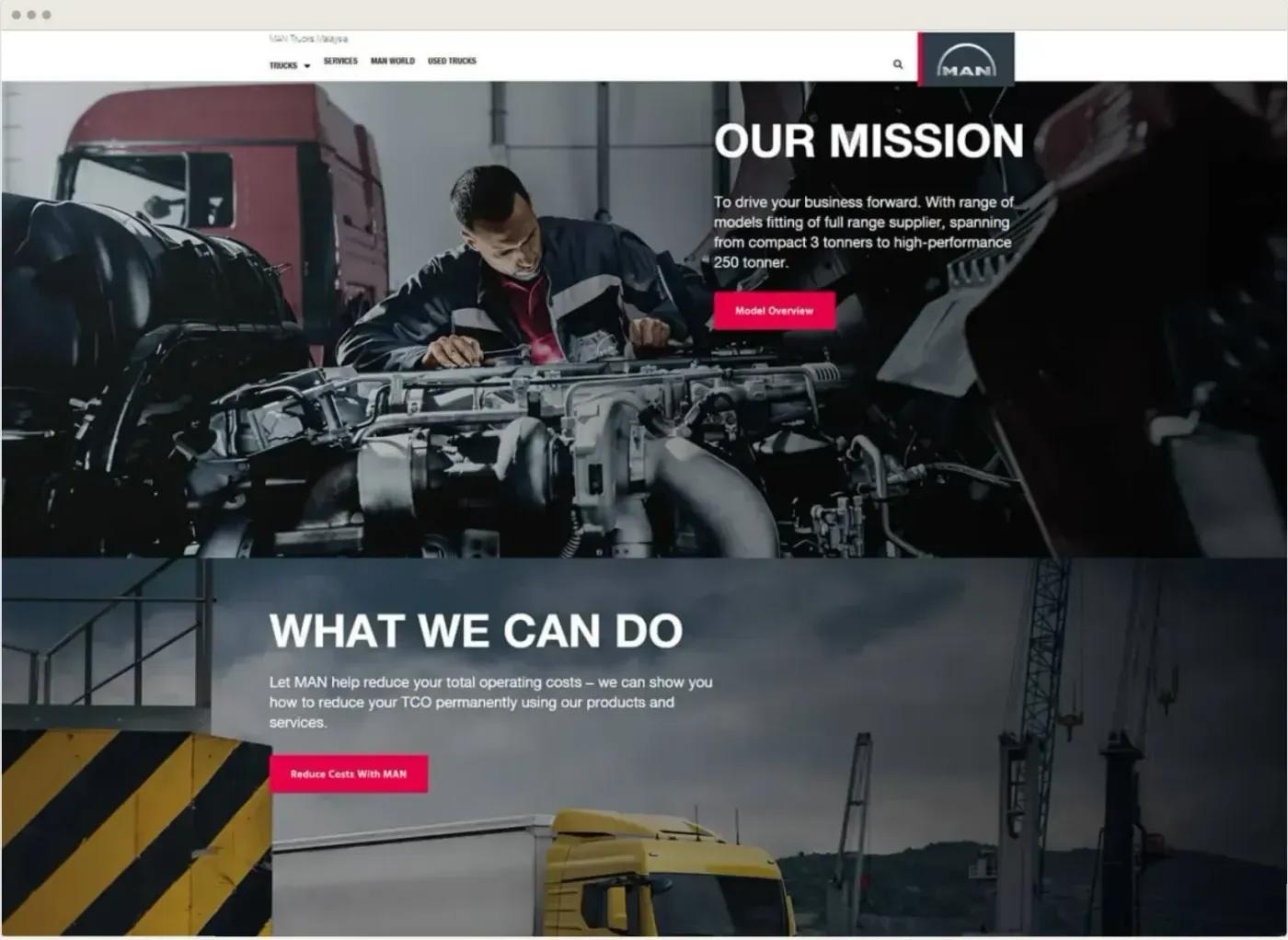
Real photographs carry a page like this. On the MAN Trucks Malaysia site I built, workshop and fleet photography does the selling before anyone reads a line.
Showing CIDB, ISO and safety without clutter
Registrations help only when the visitor can check them. A footer line saying “CIDB registered” does little. A page that shows the grade, the category and specialisation, the registration validity and the registered company name does a lot.
A registrations block can be this plain:
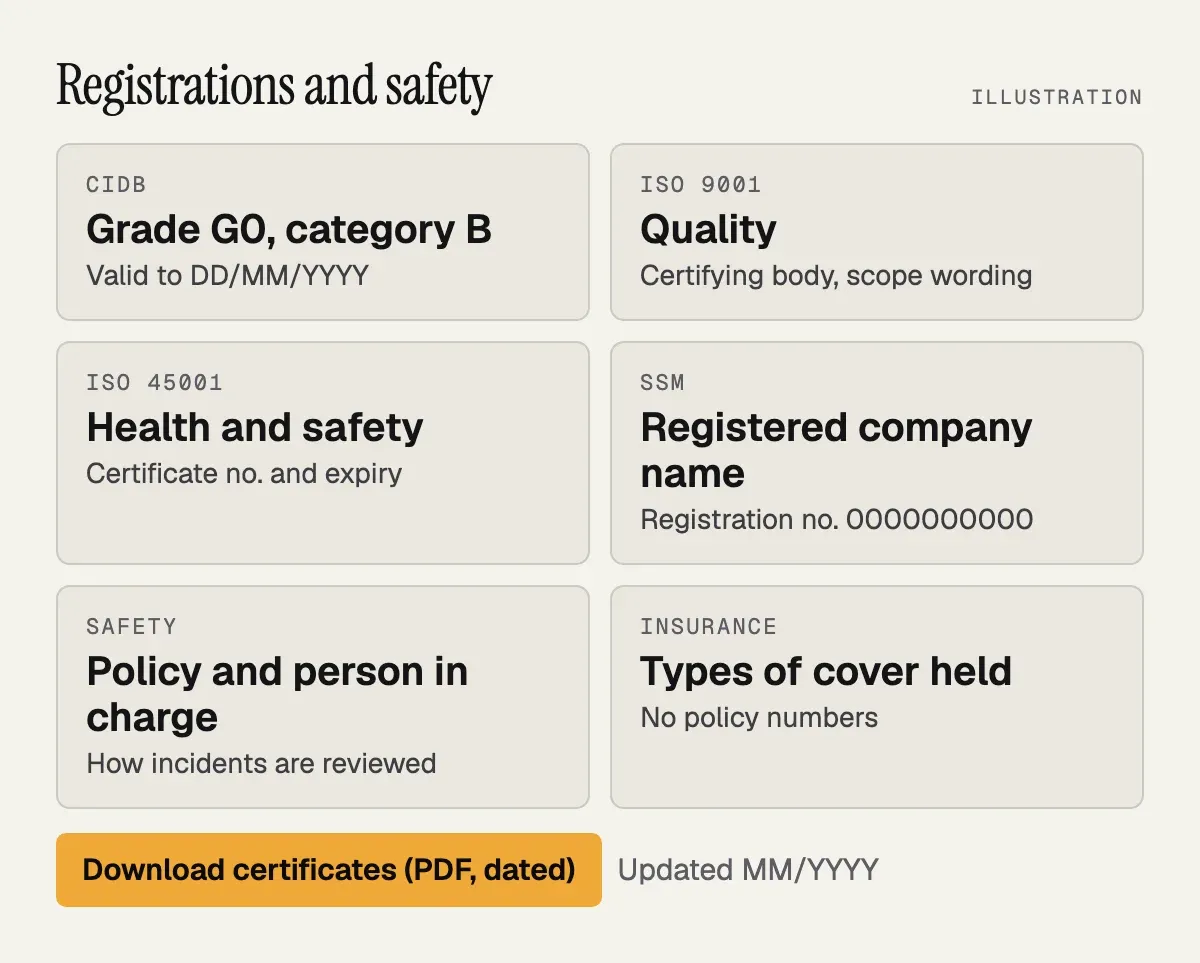
- CIDB registration. Contractors in Malaysia are registered with CIDB in grades, and the grade limits the size of public projects you can tender for. Show your grade and category exactly as they appear on your certificate, and update the page when you renew.
- ISO certifications. If you hold ISO 9001 (quality), ISO 14001 (environment) or ISO 45001 (occupational health and safety), show the certificate, the certifying body and the scope wording. Scope matters: an evaluator may check that the scope covers the work they want to award.
- Safety record. State your safety policy, the person responsible and how incidents are reported and reviewed. If your record is good, say so with facts you can document. If you have no numbers to show, do not invent any.
- Insurance and licences. List the types of cover you carry and any licences for specialist works, without publishing policy numbers.
| Signal | Where to show it | What to include |
|---|---|---|
| CIDB registration | Registrations page, linked from the footer | Grade, category, specialisation, validity |
| ISO certificates | Registrations page and the dated PDF | Certifying body, scope wording, expiry |
| Safety record | Safety page | Policy, person responsible, incident review |
| Insurance and licences | Registrations page | Types of cover and licence, no policy numbers |
| SSM details | Footer and contact page | Registered company name and number |
Put the originals in a downloadable PDF with the date, and keep the web page as the readable summary. Never show an expired certificate. An expired date on a live website is worse than no certificate at all.
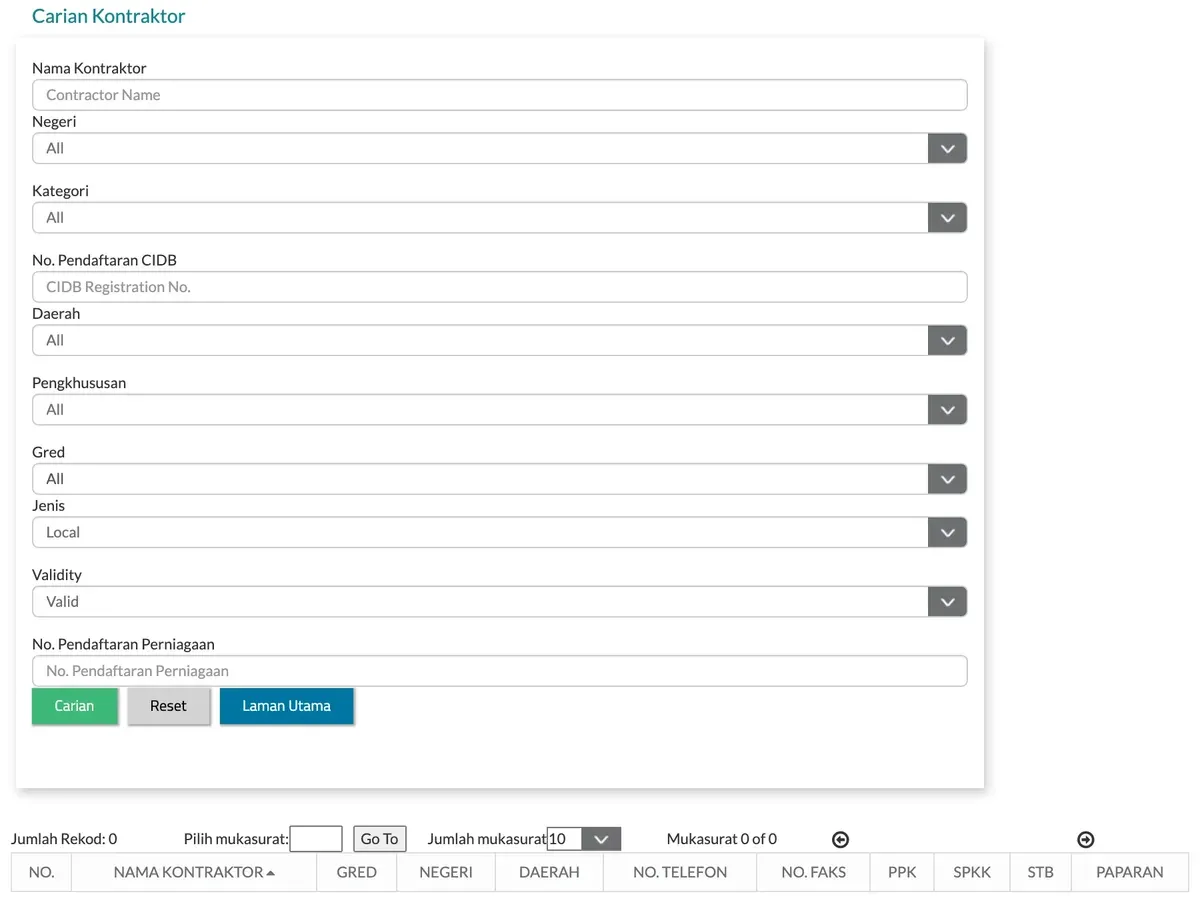
Remember that the buyer can check. CIDB runs a public contractor search, so whatever your site says about grade and validity should match it exactly.
Which pages first, if the budget is tight
Not every contractor needs a ten-page site in week one. If you must stage the work, build in this order: home page with a clear statement of what you do and where; projects with at least six real entries; one page for registrations and safety; contact with WhatsApp and a quotation form. Services pages, news and a second language follow once those four are live and the enquiries start. A small site that is complete and current is better than a large one with empty sections.
The order, drawn out:
Questions to ask a web designer before you hire
Ask any provider, me included, these questions and compare the answers in writing.
- Who owns the domain, hosting and WordPress login after launch? The answer should be you, from day one.
- Can my staff add a project and edit a certificate without calling you? Ask to see the editing screen, not a promise.
- What do you need from me, and by when? Delays in photos and certificates are the main reason sites run late.
- How will you measure enquiries? You should hear about WhatsApp taps and form submissions, not only visitor counts.
- What happens after launch? Updates, backups and security fixes should have a named owner. See the Website Care Plan for how I handle that.
- What is not included? Copywriting, extra pages, translation and stock photography are the usual extras.
To compare answers side by side:
| Question | A good answer | A warning sign |
|---|---|---|
| Who owns domain, hosting, login? | You, from day one | The designer keeps the login |
| Can my staff add a project? | Shows you the editing screen | “Just send it to us” |
| What do you need, by when? | A dated content list | “Whenever you are ready” |
| How will you measure enquiries? | WhatsApp taps and form submissions | Visitor counts only |
| What happens after launch? | A named owner for updates and backups | “Call us if it breaks” |
| What is not included? | A written list of extras | Extras you find on the invoice |
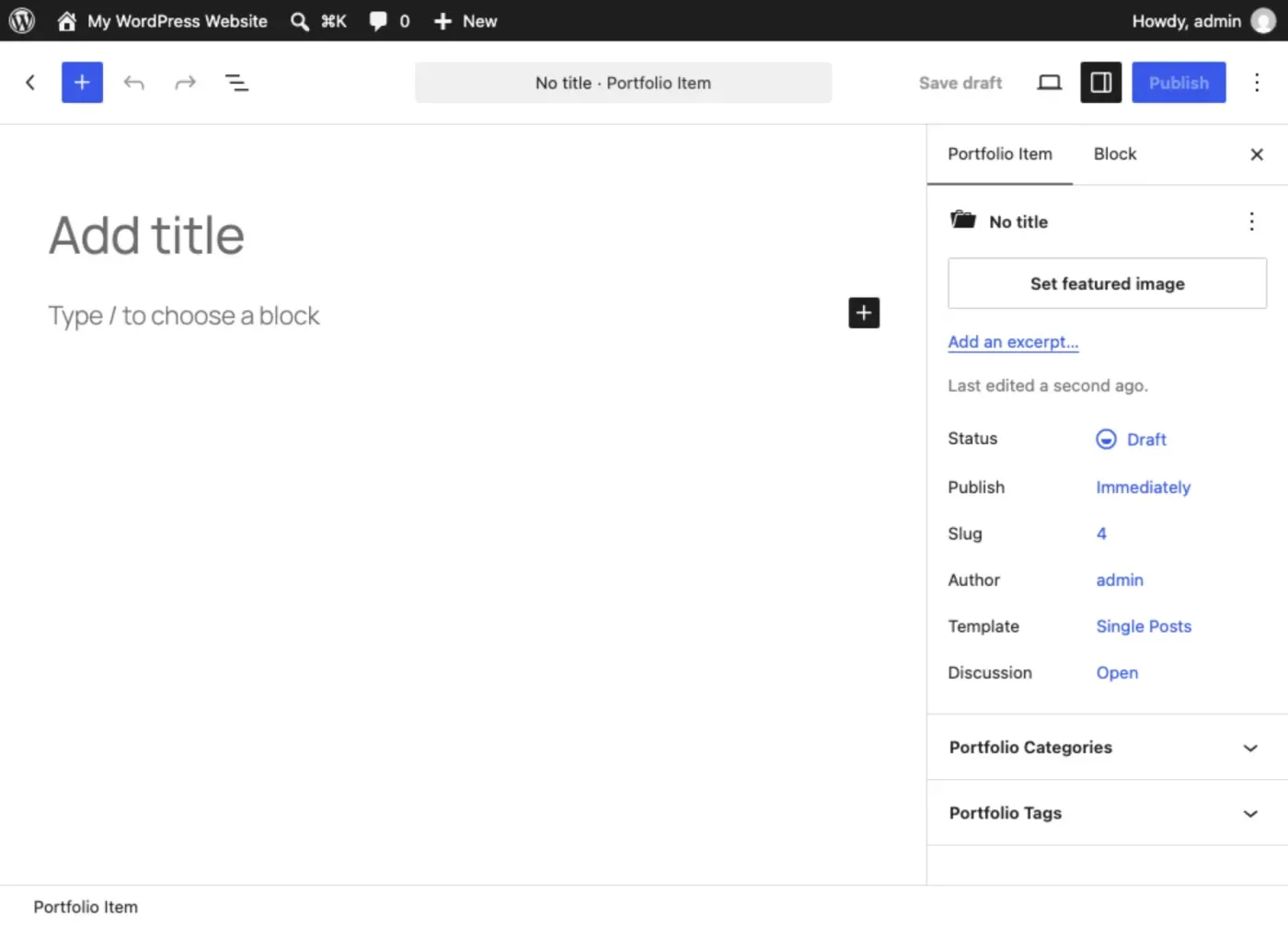
This is what “show me the editing screen” should look like: a project entry with a title, a description, a featured image and categories for sector.
A provider who answers these clearly and puts the price in writing is worth more than the cheapest quote. The ranges in my price guide show what a freelancer and an agency typically charge: a freelance web designer RM1,500 to RM8,000, an agency RM5,000 to RM30,000+.
Getting found by people who do not know you yet
Referrals will always be the main route, but a well-built site also earns searches from developers and owners looking for a contractor in a particular place. The pages that do this are the service pages and the project pages, each with the city or district in the headline and in the first paragraph. Keep your Google Business Profile in line with the site: same company name, same address, same phone. My notes on this are on the Google Business Profile page, and the SEO services page covers what is worth doing beyond the basics.
The searches below are typical examples, not measured volumes; what matters is that each kind has a page that answers it.
| Example search | Kind of search | Page that answers it |
|---|---|---|
| “M&E contractor Selangor” | Service plus place | Service page with the state in the headline |
| “renovation contractor Cheras” | Service plus district | Service page and projects located there |
| Your company name | Check after a referral | Home page and Google Business Profile |
| “hospital fit-out contractor” | Project type | Projects filtered by sector |
| “kontraktor binaan Selangor” | Bahasa Malaysia search | The Bahasa Malaysia service page |
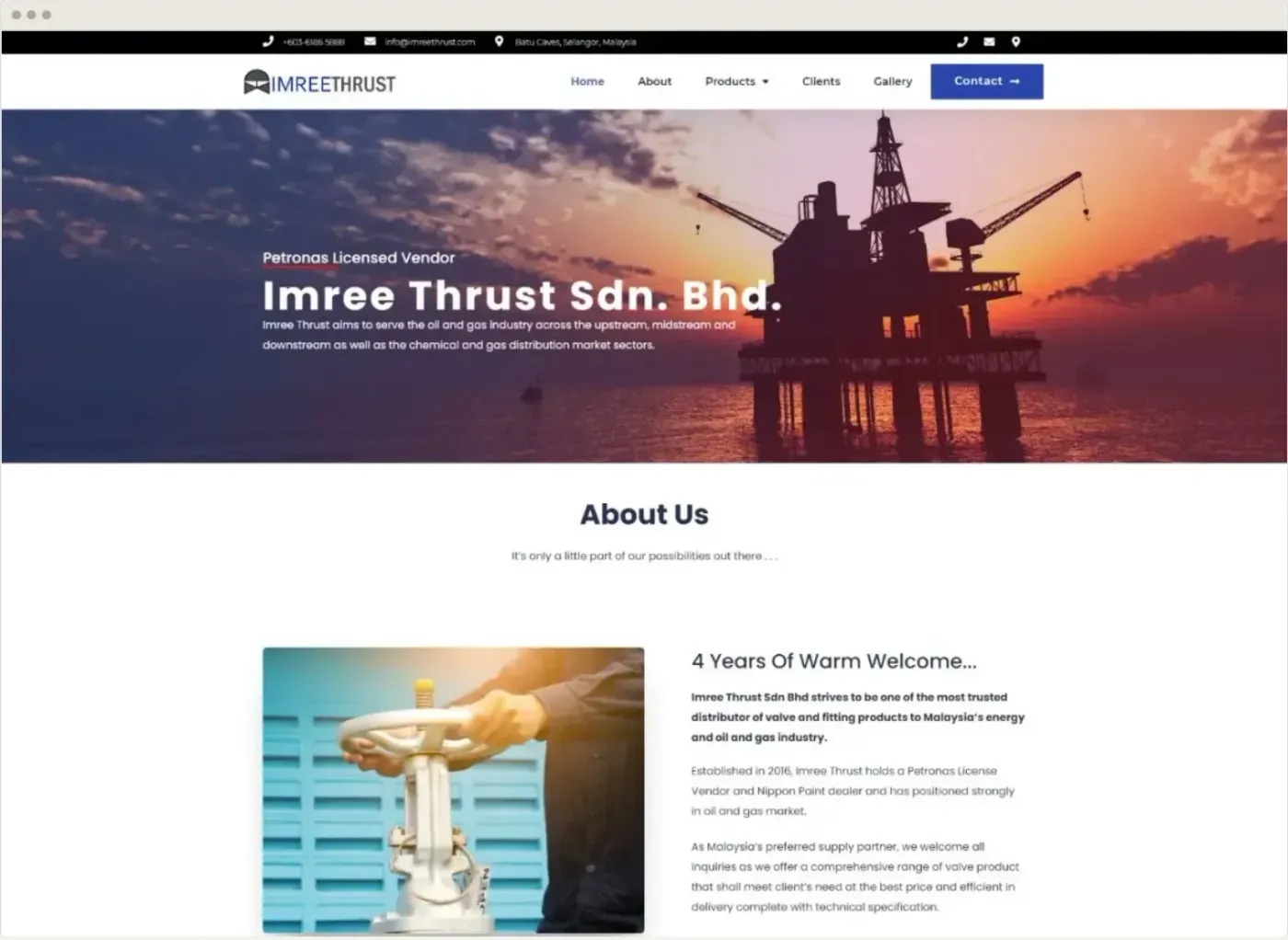
The ImreeThrust site I designed shows the phone number, email and Batu Caves, Selangor address in a strip above the menu, the same details that should match the Google listing.
How to judge the finished site
Before launch, check it on your own phone using mobile data, not office Wi-Fi. Tap every phone number and WhatsApp button. Submit the quotation form and confirm that the right person receives it within minutes. Open the site as if you were a procurement officer: in thirty seconds, can you see what the company does, one relevant project, the CIDB grade and a contact? If not, the site is not finished, however good it looks.
Print this and run it on launch day:
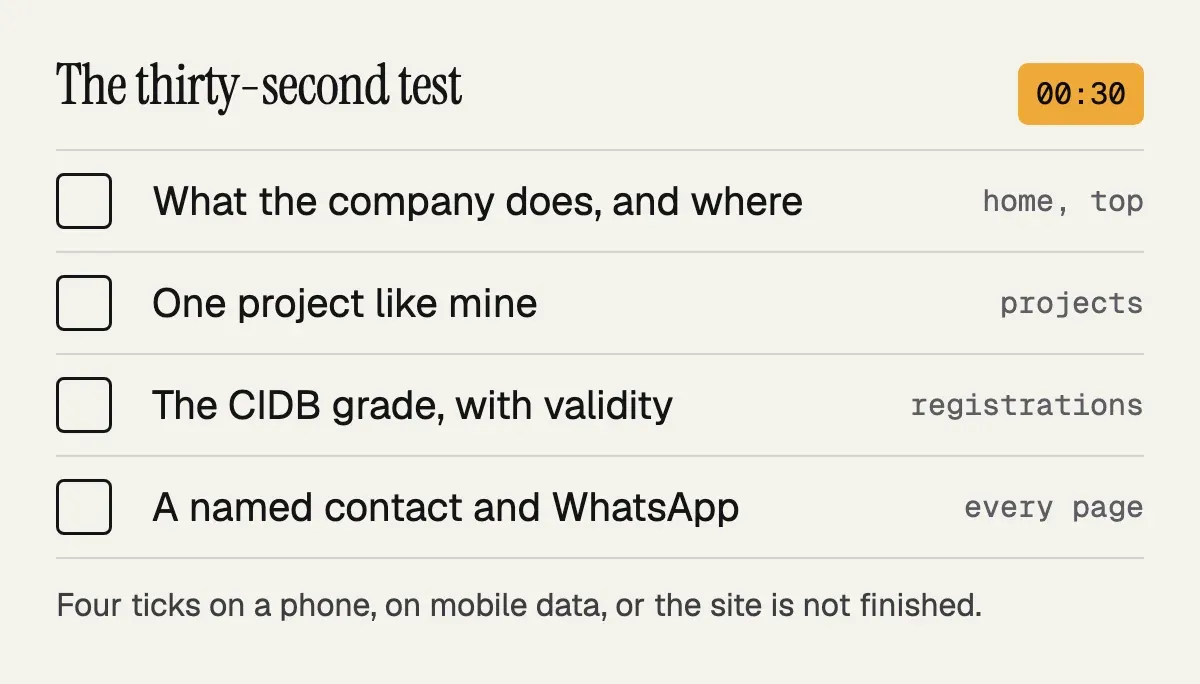
And the rest of the launch checks:
| Check | How | Pass when |
|---|---|---|
| Speed | Home and one project, mobile data | Usable in under three seconds |
| Phone numbers | Tap each one | The dialler opens |
| WhatsApp buttons | Tap each one | Chat opens, message filled in |
| Quotation form | Send a test | The right person has it in minutes |
| Thirty-second test | Act as a buyer | All four items found |
What it costs and how long it takes
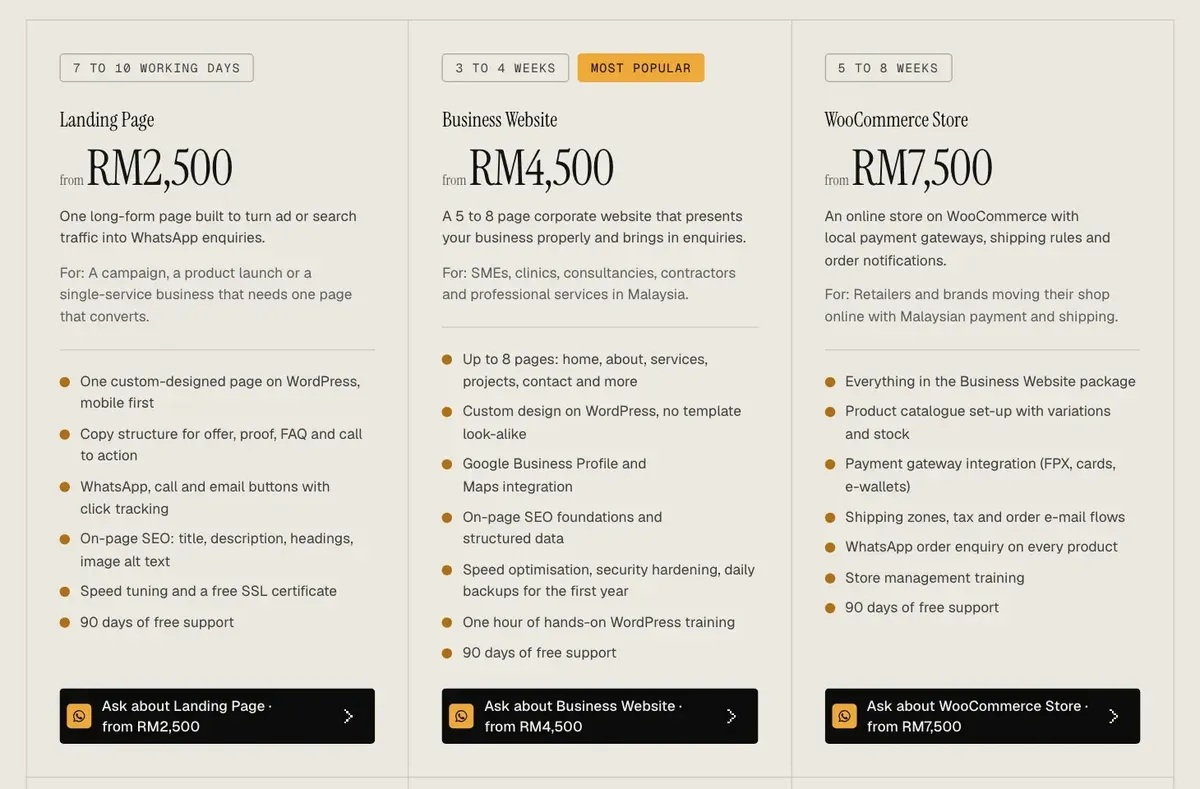
A business website with projects, services, certifications, team and a quotation flow starts at RM4,500 and takes three to four weeks from the day you hand over the content: project photos, certificates, the services list and the team details. A single-page site for a small renovation or specialist contractor starts at RM2,500. The full breakdown is on the pricing page.
| Package | From, and how long | Fits |
|---|---|---|
| Landing Page | RM2,500, 7 to 10 working days | A small renovation or specialist contractor |
| Business Website | RM4,500, 3 to 4 weeks | Projects, services, certifications, team and a quotation flow |
| Website Care Plan | RM250 a month, from the week you sign up | Updates, backups and security after launch |
The site is built on WordPress so your office can add projects and update certificates without calling anyone; the platform and what the build includes are on the WordPress website design page. After launch the Website Care Plan keeps it updated and backed up, which matters for a company whose site is checked during tenders.
The same packages as they appear on my pricing page:
The mistakes I see most
Projects pages with no dates and no locations, which make a company look inactive. A phone number in a header image that cannot be tapped. A contact form that sends to an email nobody checks. A site built by a relative in 2016 on a theme that no longer updates. An office address that differs from the one on the SSM record and the Google listing. Each of these costs real tenders, and each is cheap to fix.
| Mistake | What the visitor concludes | The fix |
|---|---|---|
| Projects with no dates or locations | The company is inactive | Add the year and town to every entry |
| Phone number inside a header image | They cannot tap to call | Make it a real, tappable link |
| Form sends to an unread inbox | Nobody replies | Send to a named person and test it monthly |
| 2016 theme that no longer updates | The company is neglected | Rebuild on maintained WordPress |
| Address differs from SSM and Google | Which one is real? | One address, everywhere |
The last one is the easiest to check: the three records below should match word for word.
Next step
If you run a construction, renovation, engineering or specialist contracting company in Malaysia, send your company name and a link to your current site or profile on WhatsApp. I reply within one working day with a written quotation and the three things I would fix first.
What happens after you send it: