Freelance
Freelance Web Designer vs Agency in Malaysia
An honest comparison of a freelance web designer and an agency in Malaysia: cost, speed, risk, who does the work, and when each is the right choice.
 By Zahid Aramai
Every week someone asks me a version of the same question: should I hire a freelancer or an agency for my website? I am a freelancer, so you should read this knowing that. I have also worked inside agencies and subcontracted for them, so I know what happens on the other side of the invoice. Here is the comparison as honestly as I can write it.
Who actually does the work
At an agency you meet a director or an account manager. The website is then designed by a designer, built by a developer and project-managed by a third person, and after launch you talk to whoever is on support that month. Each hand-off loses a little of what you said in the first meeting.
With a freelancer, the person you brief is the person who designs, builds, launches and answers the phone afterwards. There is no translation layer. The flip side is that the freelancer’s range is their own range: if your project needs a motion designer and a Laravel developer and a copywriter all at once, one person cannot be all of them at the same level.
The difference is easiest to see as a chain of people between you and the finished site.
What each side is good at
Agencies are built for volume and breadth. They can put a strategist, a copywriter, a photographer and a developer on one brief, and they can survive losing any single person. If you run a group of companies with several brands, an agency’s process is a feature, not a cost.
Freelancers are built for depth and speed. One person who has solved your type of problem before can usually make decisions in minutes that a larger team makes in meetings. The trade-off is that you depend on that person’s judgment, so their track record matters more than any process document.
Side by side, the strengths look like this.
| Strength | Agency | Freelancer |
|---|---|---|
| Several specialists on one brief | Yes, built for it | Only through partners |
| Survives losing one person | Yes | Depends on handover and ownership |
| Speed of decisions | Meetings and sign-offs | Minutes, by the person doing the work |
| Multi-brand groups | Process is a feature | Workable for one or two brands |
| Price for an SME website | Higher, carries overhead | Lower for the same scope |
| What you are trusting | The process | The person’s track record |
Cost
The price difference is mostly overhead. An agency carries rent in Bangsar South or Petaling Jaya, salaries for people who are not working on your project, and a sales process. A freelancer carries a laptop and a reputation.
For a typical SME business website in Malaysia, five to eight pages with custom design on WordPress, my packages start at RM4,500. Agency quotations for comparable scope commonly fall between RM8,000 and RM20,000. Below both sit template resellers and offshore marketplaces at RM800 to RM2,000, which buy you a theme with your logo pasted in. The full price bands are on the pricing page, with what moves a quotation up or down.
Cheaper is not automatically better. A website that costs RM1,500 and brings no enquiries is the most expensive one you can buy, because you will pay for it twice: once now and once when you replace it.
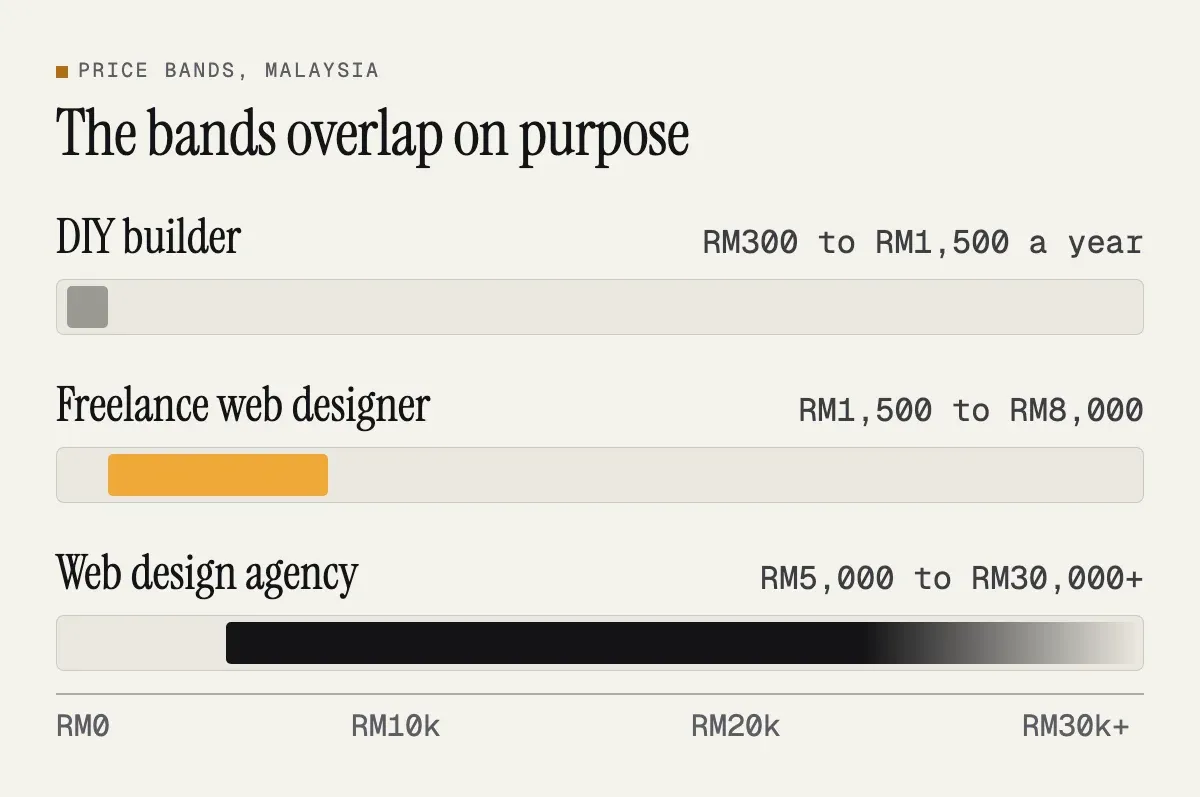
The comparison table on this site gives the rough bands: do-it-yourself builders at RM300 to RM1,500 a year, a freelance web designer at RM1,500 to RM8,000, and a web design agency at RM5,000 to RM30,000 and above. Those ranges overlap on purpose. A senior freelancer can cost more than a junior agency team, and a small agency can cost less than a famous freelancer. Judge the scope, the person and the proof, not the category.
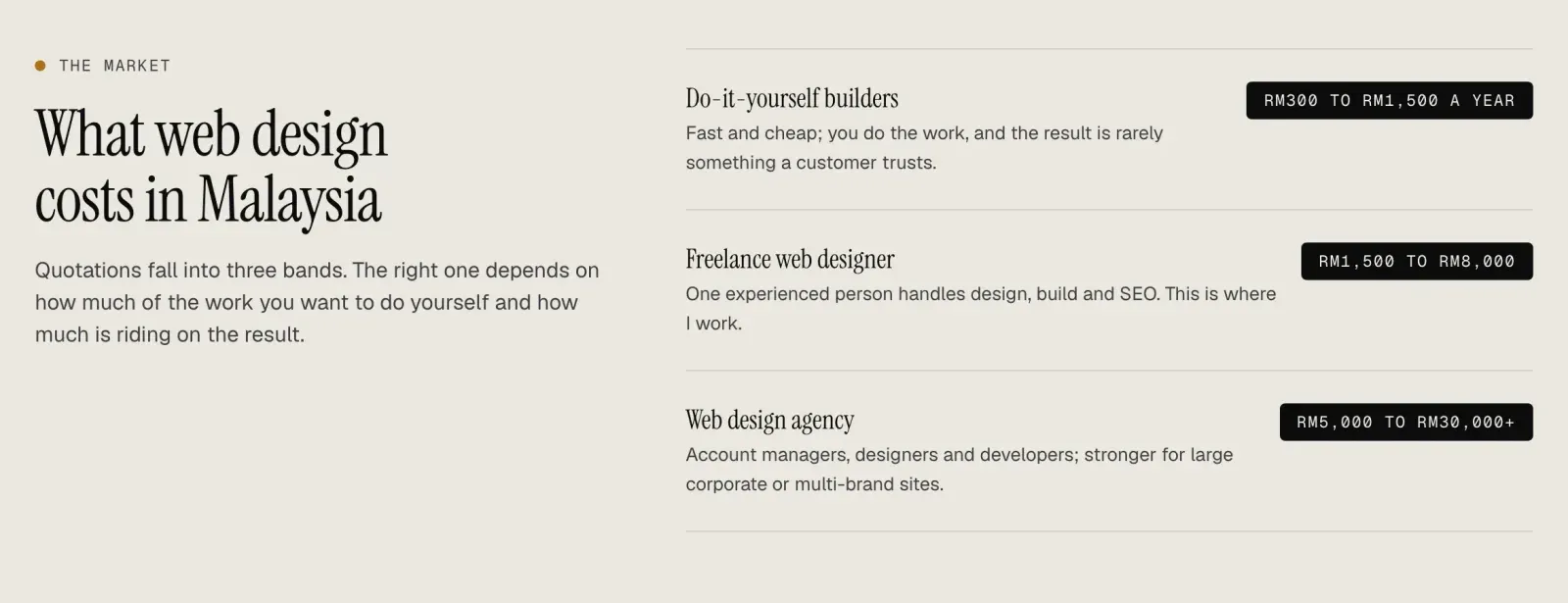
Drawn to scale, the three bands look like this. Note how far the agency band reaches and how much it overlaps the freelance band.
How to compare two quotations properly
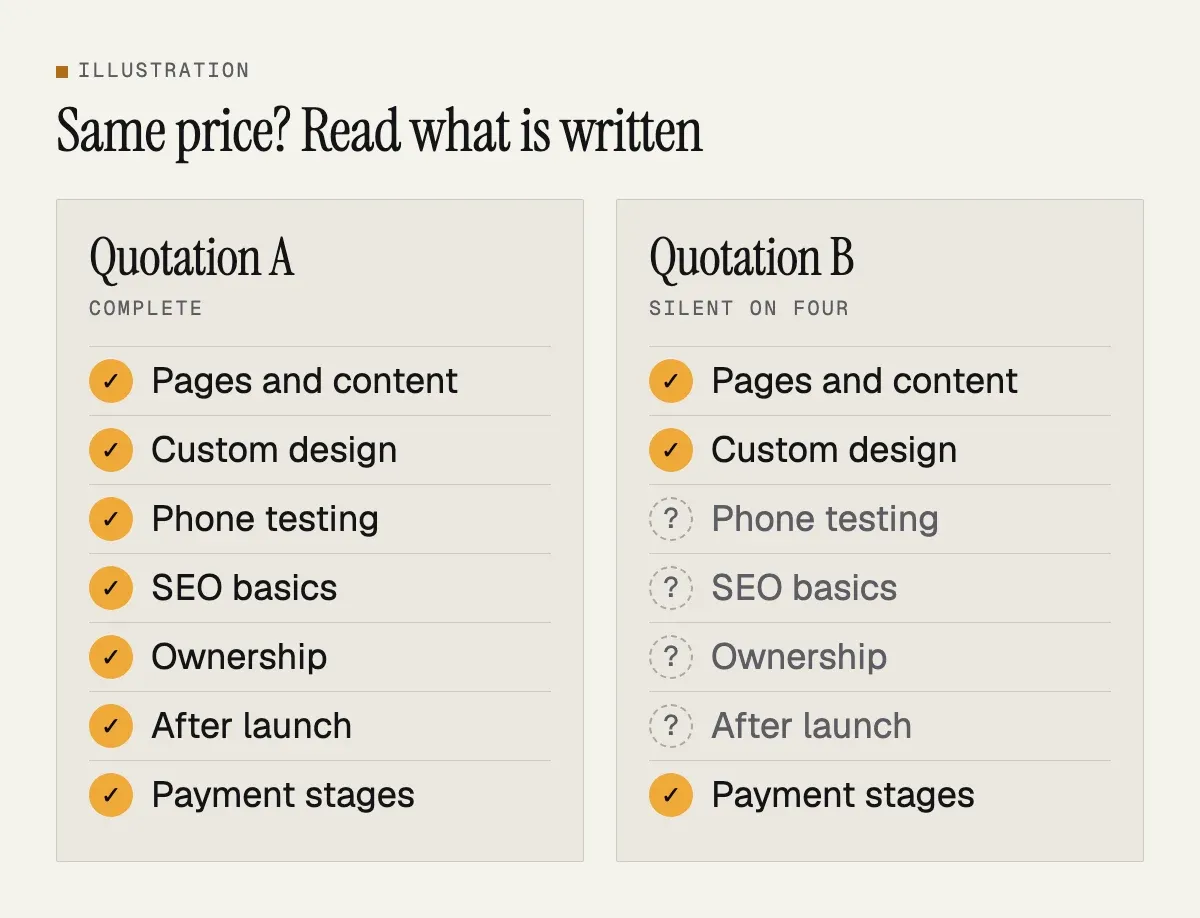
Put the quotations side by side and check that each one states the same things:
- Number of pages and who writes the content.
- Whether the design is custom or a modified template.
- Whether the site works well on phones, and how that is tested.
- What is included for SEO: page titles, descriptions, a sitemap, redirects if you are replacing an old site.
- Who owns the domain, hosting and files at the end.
- What happens after launch: support period, training, and the monthly cost of care.
- The payment schedule, and what you get at each stage.
A quotation that is silent on any of these is not cheaper, it is incomplete. The missing items turn up later as extra charges.
| Item on the quotation | What it should state, and why |
|---|---|
| Pages and content | The page count and who writes the text; most delays start here |
| Design | Custom, or a modified template; templates look like templates |
| Phones | Built mobile first, and how it is tested; most visitors use a phone |
| SEO | Titles, descriptions, sitemap and redirects; redirects protect rankings |
| Who owns it | Domain, hosting and files in your name; decides whether you can leave |
| After launch | Support period, training and care cost; sites need monthly work |
| Payment | The schedule and what each stage delivers; protects both sides |
Speed and attention
A freelancer with a sane workload starts your project when they say they will and finishes a business website in three to four weeks from the day the content is ready. Agencies run queues; your project waits behind the retainer clients, and a three-week build becomes a three-month build. On the other hand a freelancer who takes on too much becomes the same bottleneck, so ask how many projects they run at once. I run a handful, which is why I can quote a start date.
Risk, and how to remove it
The real risk with a freelancer is continuity: illness, a career change, a move abroad. The real risk with an agency is churn: the designer who understood your business leaves and nobody tells you.
Both risks are solved the same way. Insist that the website is built on an open platform like WordPress, that the domain and hosting are registered in your company’s name, and that you receive every login on launch day. A site built that way can be picked up by any competent designer in a day. A site built on an agency’s proprietary system or registered under the freelancer’s account cannot. This is the question to ask before price.
| With a freelancer | With an agency |
|---|---|
| Risk: continuity, such as illness, a new career or a move abroad | Risk: churn, when your designer leaves and nobody tells you |
| Warning sign: accounts registered in the freelancer’s name | Warning sign: a proprietary system only the agency can edit |
| Fix: open platform, your accounts, every login | Fix: the same three things |
Quality
This is where generalisations fail. There are excellent agencies and careless ones, excellent freelancers and careless ones. The signals that predict quality are the same for both: a portfolio of live sites you can click through, named clients you can contact, Google reviews under a real name, a written scope before a price, and a first conversation that is mostly questions about your business rather than a pitch.
What I would add is that a freelancer’s portfolio is their own work. An agency’s portfolio may have been produced by people who left two years ago.
| Signal | How to check it |
|---|---|
| Live portfolio | Click through to the real sites, not mock-ups |
| Named clients | Ask for one you can call |
| Google reviews | Real names, spread over years |
| Written scope before price | The quotation lists what is in and out |
| Questions before a pitch | The first call is about your business |
| Who made the portfolio | Ask whether those people still work there, agencies especially |
Questions to ask before you sign
Whoever you choose, ask these in the first conversation. The answers tell you more than the portfolio does.
- Who will personally design and build my website, and will anyone else touch it?
- How many projects are you running right now, and when could mine start?
- Which platform will it be built on, and could another designer take it over?
- Will the domain and hosting be registered in my company’s name?
- What do you need from me, and by when, to hit the launch date?
- What does the quotation exclude?
- How do you handle changes after the first design is shown?
- What happens if I want to leave in a year?
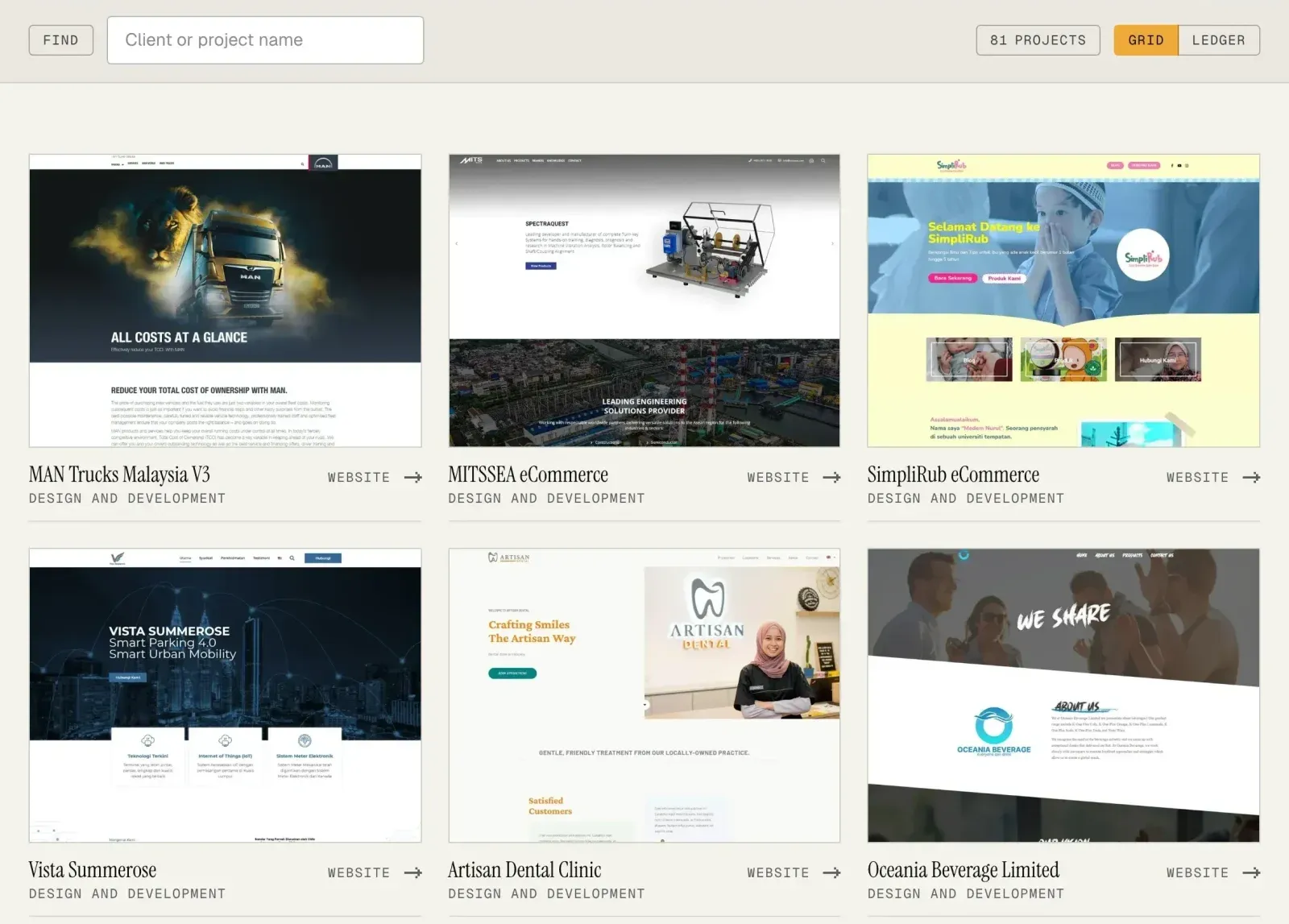
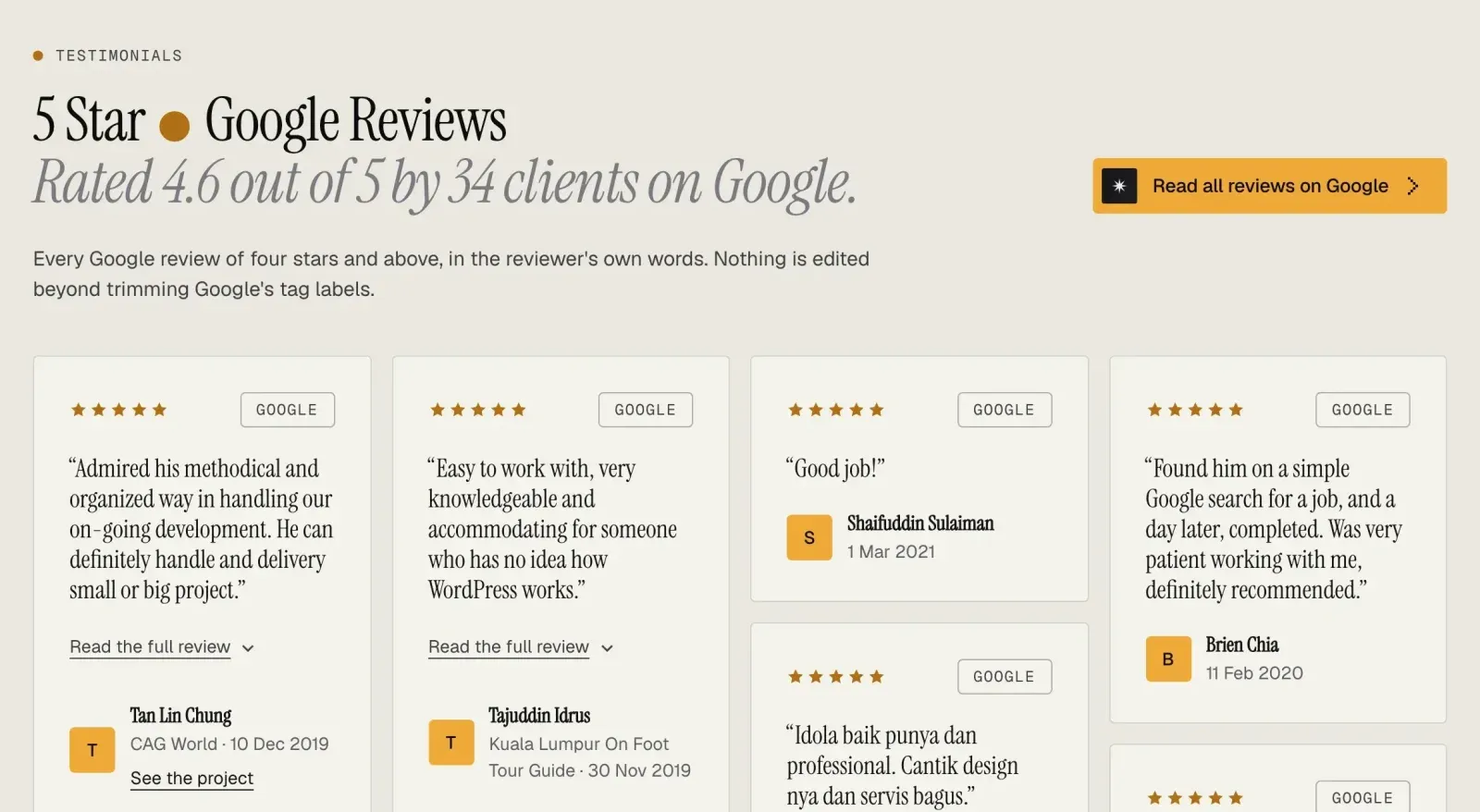
A good provider answers plainly and does not mind the questions. Defensiveness is also an answer. You can see real work on the past projects page and read what clients said on the testimonial page; any provider you consider should be able to show you the same kind of thing.
Here is what to listen for in the answers.
| Question | Good answer | Warning sign |
|---|---|---|
| Who builds it? | A name, and who helps | “Our team”, no names |
| How many projects now? | A number and a start date | “Any time you like” |
| Which platform? | An open one, like WordPress | A closed builder |
| Whose name on the domain? | Yours | Theirs |
| What do you need from me? | A content list with dates | Nothing specific |
| What is excluded? | A written list | “All included” |
| How are changes handled? | Rounds in the quotation | Surprise bills |
| What if I leave in a year? | Full export and logins | A fee to release files |
Mistakes I see businesses make
In one table first, then one by one.
| Mistake | What it costs later | The fix |
|---|---|---|
| Choosing on price alone | A site that brings no enquiries, paid for twice | Compare scope line by line |
| Choosing on a pitch deck | Polished slides, ordinary website | Ask for live sites and an owner to call |
| Skipping the content question | Weeks of delay waiting for text and photos | Name who writes and who shoots, in writing |
| Letting the provider own the accounts | You cannot leave without their help | Everything in your name from day one |
| Forgetting search | A brochure in a drawer | Ask what SEO and Google Business Profile set-up includes |
Choosing on price alone
The cheapest quotation usually leaves things out. The cost shows up later as a website that looks fine and brings no enquiries.
Choosing on a pitch deck
A beautiful presentation proves that someone can make presentations. Ask to see live sites and to speak to the owner of one of them.
Skipping the content question
Most delays come from the client side: text and photos arrive late. Whoever builds your site, decide in advance who writes the words and who takes the photos. Say it in the quotation.
Letting the provider own the accounts
If the designer registers the domain, the hosting and the Google accounts in their own name, they hold your business hostage whether they mean to or not. Everything should be in your name from the start.
Forgetting that the site needs to be found
A site nobody finds is a brochure in a drawer. Ask what is included for SEO and how local search, such as Google Business Profile, will be set up.
What you should receive on launch day
Regardless of who builds it, you should leave with a written handover:
- Logins for the website admin, hosting and domain, in your name.
- A short training session so you can edit text and images yourself.
- A backup of the site and its database.
- A clear statement of what is covered by support and for how long.
- A list of plugins and tools used, so any future designer can see what they are inheriting.
If you want to know how this works on a WordPress build specifically, see the WordPress website design page.
After launch
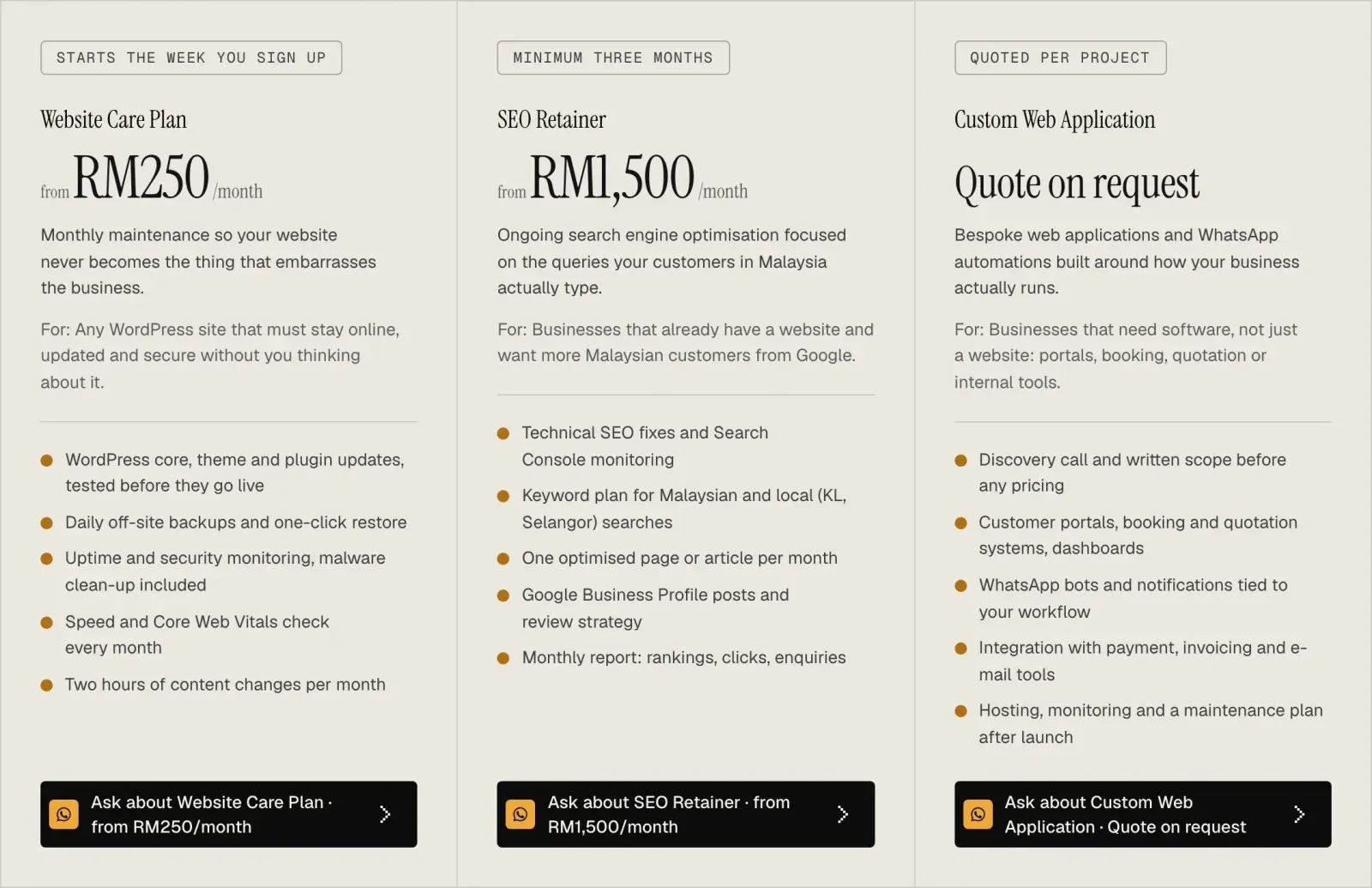
Websites need updates, backups, security and small changes every month. Agencies sell this as a retainer, often at RM500 to RM1,500 a month. Freelancers either offer a care plan or disappear after launch; ask which. Mine starts at RM250 a month and is described on the website maintenance page. Either way, make sure someone is responsible for the site after the launch party, because the hacked WordPress sites I clean up every year are nearly all orphans.
| Who looks after the site | Monthly cost |
|---|---|
| Agency retainer | Often RM500 to RM1,500 |
| Freelancer care plan | Mine starts at RM250 |
| Nobody | RM0 until something breaks |
When to choose which
Choose an agency when the project is genuinely multi-disciplinary and simultaneous, when your procurement requires a registered firm with a team and a tender process, or when the budget is large enough that coordination is the job.
Choose a freelancer when you want the person who understands your business to be the person building the site, when the budget is in the thousands rather than the tens of thousands, when speed and direct communication matter, and when the website’s job is clear: bring enquiries, sell products, or present the company properly.
The same rules as a quick lookup:
| Choose an agency when | Choose a freelancer when |
|---|---|
| Several specialists are needed at once, on one deadline | You want the person who understands the business to build it |
| Procurement requires a registered firm and a tender | The budget is in the thousands |
| The budget is in the tens of thousands and coordination is the job | Speed and direct communication matter |
| Several brands need one shared process | The site’s job is clear: enquiries, sales, a proper company presence |
Most Malaysian SMEs, clinics, consultancies, contractors and retailers are in the second group. That is who I build for, and what the service includes is on the freelance web designer page.
A middle path
You do not have to choose absolutely. Some businesses use an agency for brand identity and a freelancer for the website. Others use a freelancer to build and a separate specialist for advertising. What matters is that one person is clearly responsible for the website itself, and that the pieces connect through open, documented tools.
Next step
Whichever way you lean, get two or three written quotations and compare the scope, not just the price. If one of them should be mine, send your business name and what the website must do on WhatsApp. You will have a quotation within one working day, from the person who would build it.